Crusader Ministry
Program & Donor-Support Plan
November 2026
Practical compassion. Useful skills. A stronger community.
Crusader Ministry serves people through community outreach and personal visits. Its next proposed step is to create a supervised youth manufacturing program that introduces practical skills and helps young people explore further education and work.
Proposed mission statement: To share the love of Christ through practical service, meaningful relationships, and hands-on learning that helps people move forward with dignity and hope.
Four clear ways to help
1. Community Outreach Fund. Help purchase, prepare, and distribute meals and clothing for people experiencing homelessness. Gifts can cover food, serving supplies, and approved outreach transportation costs.
2. Veterans & Seniors Care Fund. Support visits and facility-approved items that respond to residents’ actual needs. Gifts can help provide personal-care supplies, room comfort items, activity supplies, and Bibles when requested.
3. Youth Skills & Manufacturing Fund. Help launch a proposed introductory program in design, measurement, 3D printing, laser processes, and computer-controlled machining. Support can include suitable equipment, qualified instruction, software, and project materials.
4. Ministry Infrastructure Fund. Help equip the warehouse, classroom, and office with safe workstations, tables, chairs, computers, storage, and essential operating support.
Donors may also give to General Ministry Support, an unrestricted option that allows leadership to meet the greatest current need across the ministry. Cash, suitable equipment, supplies, volunteer service, and business partnerships can all help.
What is happening now—and what is proposed
Meal and clothing outreach, along with visits to veterans and seniors, are existing activities described by ministry leadership. The youth curriculum, dedicated care funds, facility expansion, and operating procedures in this plan are proposals. Launch dates and funding goals will be set after leadership approves the plan and confirms costs.
Identity to verify before donor distribution: “Crusader Ministry” and “Crusader Motorcycle Ministry” are reported public names; “Creative Ministry” is the reported legal nonprofit name. Confirm the exact legal name, any registered operating name, donation payee, and charitable status before issuing the final packet. This plan does not establish tax-deductibility.
Community Outreach & Resident Care
Two service programs with clear uses for donations
1. Community Outreach Fund
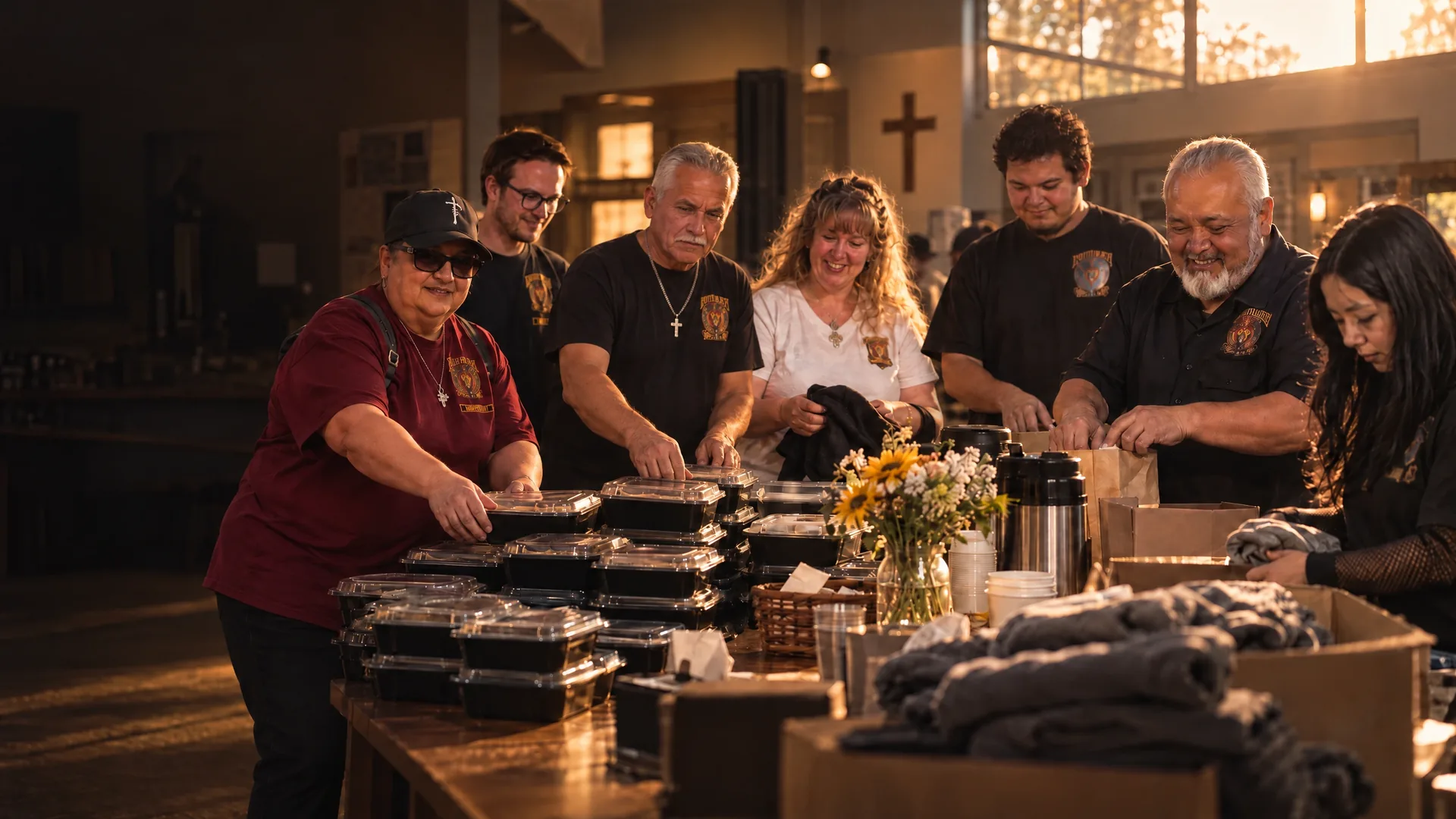
Purpose and current activity. Provide meals and clothing to people experiencing homelessness. The ministry currently purchases and cooks food, buys serving supplies, transports supplies in volunteers’ vehicles, and distributes donated clothing at outreach locations.
What support would pay for. Food ingredients, drinking water, plates, utensils, napkins, food-safe packaging, cleaning supplies, and approved fuel or mileage reimbursement for ministry trips. Clothing support may cover sorting supplies, storage bins, laundry where appropriate, and needed sizes or seasonal items that are not available through donations.
How the program would work. A designated outreach lead would plan each event, confirm the location and any permissions, arrange food-safe preparation and transport, and record expenses. Volunteers would sort clothing before distribution. Assistance should be offered respectfully, without requiring participation in prayer or religious activities.
Specific donor opportunities. Sponsor the documented cost of one meal outreach; provide approved packaged food or serving supplies; organize a clothing collection around requested sizes; or contribute toward recurring outreach expenses. Confirm needs before accepting food or clothing so gifts can be used safely and promptly.
What to report. Outreach events completed, meals served, clothing items distributed, actual event costs, and volunteer participation. Count meals as meals—not automatically as unique people served. Collect personal information only when needed and use photographs only with appropriate consent.
2. Veterans & Seniors Care Fund
Purpose and current activity. Build relationships through visits to veterans and senior residents at participating homes or facilities. The proposed care fund would allow the ministry to respond to practical needs instead of arriving only to say hello.
What support would pay for. Facility-approved hygiene items, socks, blankets, large-print reading materials, activity supplies, modest comfort items for a room, and Bibles requested by residents. The fund may also cover approved travel and supplies for coordinated events. Purchases would follow a written needs list and per-request spending approval—not informal promises to individual residents.
How the program would work. A care coordinator would work with facility staff, confirm resident preferences and infection-control requirements, and arrange visits or deliveries. Staff should approve room items, food, and activities before purchase. Volunteers would not provide medical care, administer medication, or bypass facility rules.
Specific donor opportunities. Sponsor a facility-approved care package, contribute to a resident-needs reserve, supply requested comfort items, or support a coordinated activity day. Ministry leadership would select recipients using consistent need-based criteria; donors would support the program rather than control gifts to named individuals.
What to report. Visits or events completed, participating facilities, approved needs met, care items delivered, and program spending. Describe impact without publishing residents’ medical details or identifying stories without permission.
Youth Skills & Manufacturing Fund
A proposed introduction to design, making, and next steps
Purpose. Help young people who need direction build confidence, practical problem-solving skills, and an understanding of education and work opportunities. The ministry’s manufacturing experience would support a structured learning environment—not an unapproved production shop staffed by children.
Proposed pilot. One age-banded group of 6–8 learners, meeting weekly for 12 sessions. A qualified technical instructor and a second vetted adult would attend every session. These are planning assumptions, not a legally established or universally safe staffing ratio. Set ages, eligibility, session length, and task permissions after local legal, safeguarding, and insurance review.
What donations would fund. Computers and design software; measuring tools and approved manual assembly supplies; supported filament 3D printers; materials; qualified instruction; safety controls; and project documentation. Later support could fund suitable laser and computer numerical control (CNC) equipment, installation, extraction, maintenance, and adult operator training. Do not accept machinery without budgeting what it takes to use it safely.
A staged equipment approach
Start with clean design workstations, measurement, software simulation, and approved manual tasks. Introduce adult-run filament printing only after a risk assessment and emissions-control plan. 3D printers can present particle and chemical emissions, hot-surface, and moving-part hazards; enclosure or low odor alone does not establish safety. Defer resin printing and solvent-intensive finishing for the pilot. [5]
Add laser or CNC demonstrations only when suitable guarding, interlocks, ventilation or extraction, approved materials, commissioning, and trained adult operation are in place. Laser processes carry fire and exposure risks; do not leave a laser running unattended or bypass its interlocks. [6] Guards and engineering controls—not protective eyewear alone—must address machinery hazards. [7]
Safeguards before enrollment
Obtain guardian consent where applicable, emergency contacts, authorized pickup procedures, and a written safeguarding and abuse-reporting process. Vet adults, keep interactions observable, provide accessible instruction, and establish first-aid, emergency, and incident-reporting arrangements. Control access to machines and restricted warehouse areas.
Conservative default for minors: design, simulation, approved manual assembly, and observation from a safe area; trained adults operate fabrication machines. Any later minor machine activity requires separate age- and task-specific legal and insurance clearance, documented competence, and qualified supervision. No unsupervised minor machine access or maintenance.
In the United States, federal employment rules restrict minors’ manufacturing and certain hazardous machinery activities. These rules do not by themselves decide the legality of a volunteer course; the participant relationship, exact equipment, state rules, and insurer conditions require review. Calling a course “training,” or issuing a ministry certificate, does not establish an exemption. [4]
Donor reporting. Track enrollment, attendance, introductory skills demonstrated, completed projects, completions, and voluntary next-step follow-up. Report education or shop referrals only when they actually occur. Do not promise college admission, accredited certification, or employment.
Proposed 12-Week Youth Curriculum
Introductory Digital Design & Fabrication
The following is a proposed sequence. Adjust pacing for learner ages and needs. Live fabrication is adult-run under the approved safety plan; video or partner demonstrations can replace equipment that is not ready.
Week 1 — Welcome and safe habits. Introduce respectful conduct, hazard reporting, stop-work authority, emergency exits, and restricted areas. Identify hazards and make a simple paper prototype without activating machines.
Week 2 — Measurement and design thinking. Learn units, dimensions, and fit. Sketch a small, non-safety-critical project such as a desk organizer or display stand.
Week 3 — Computer-aided design. Build a simple three-dimensional model. Save a design file, screenshot, and dimensioned sketch as the first portfolio evidence.
Week 4 — 3D printing fundamentals. Learn about layers, slicing, supports, and print time. Prepare digital files for an instructor check and approved adult-run printing.
Week 5 — Test and revise. Measure cooled parts, compare them with the drawing, and improve one feature. Use only approved low-risk finishing tasks; adults handle hazardous post-processing.
Week 6 — Two-dimensional design and laser exposure. Create a vector design and learn approved-material identification. Observe an authorized adult demonstration from a designated safe area, or use a recorded example.
Week 7 — CNC concepts and simulation. Explore coordinates, toolpaths, workholding, and collision risks. Simulate a toolpath; any live cutting remains with an authorized adult behind suitable guarding.
Week 8 — Assembly and quality. Assemble approved components with permitted manual tools. Check dimensions, fit, finish, and waste. Explain why a classroom prototype is not automatically safe for public use.
Week 9 — Team project planning. Choose a modest capstone project. Assign roles and prepare drawings, material needs, a basic cost estimate, and an instructor-approved risk checklist.
Week 10 — Build and improve. Make the project through approved processes. Record what failed, what changed, and why. Do not impose customer-production quotas or use unidentified donated materials.
Week 11 — Education and career pathways. Invite a vetted educator or industry speaker if available. Discuss entry requirements, assemble a small portfolio, and identify one realistic next-step inquiry.
Week 12 — Showcase and reflection. Present the design, prototype, safety decisions, and lessons learned. Complete an individual next-step plan and a final introductory safety check.
Proposed completion standard
Attend at least 10 of 12 sessions or complete approved make-up work; demonstrate every critical safety rule after any needed reteaching; document a design and prototype with at least one revision; contribute responsibly to the project; and present a next-step plan. Offer an accessible design-only route when live fabrication is inappropriate. Record participation separately from completion.
Suggested credential: “Certificate of Completion — Introductory Digital Design and Fabrication.” List dates, recorded learning hours, and introductory outcomes. This is a ministry-issued completion certificate—not accreditation, a trade license, machine authorization, or a guarantee of work.
Ministry Infrastructure Fund
Build a usable ministry space before expanding equipment
This fund would support the shared warehouse, classroom, office, and storage capacity needed for ministry operations. General-purpose furniture and office equipment belong here. Specialized training machines and their dedicated operating costs belong in the Youth Skills & Manufacturing Fund, unless a donor agreement states otherwise.
First priority: a safe, functional space
Confirm permission to use the warehouse for the proposed activities and assess occupancy, access, exits, restrooms, electrical capacity, fire protection, ventilation, and insurance. Separate food handling and snack storage from fabrication work, dust, chemicals, and machine areas. Do not assume the space is ready for youth instruction because equipment fits inside it.
Suitable early gifts may include sturdy classroom tables, chairs, workbenches, lockable tool cabinets, shelving, first-aid supplies, and approved safety equipment. Facility modifications should be quoted and approved before accepting gifts that depend on them.
Second priority: basic office and learning equipment
Request dependable computers capable of running the selected design software, monitors, a printer/scanner, secure records storage, and reliable internet service. Include software licensing, account access, backups, and ongoing support in the purchasing decision. Used computers should be serviceable, supported, and securely wiped before use.
Office needs may include desks, office chairs, paper, printer supplies, and basic bookkeeping tools. Shared room costs may include approved rent, utilities, insurance, cleaning, and routine maintenance.
Third priority: hospitality and program support
A small refrigerator in a clean, separate area, snack storage, a water station, and washable surfaces can help make the learning space welcoming. Plan for recurring snack purchases and cleaning, not just the appliance donation. Confirm food storage and electrical requirements before acceptance.
Accept the right equipment—not every equipment offer
For a machine donation, request the make, model, serial number, condition, manuals, maintenance history, included accessories, power requirements, and software needs. A qualified reviewer should inspect guards, interlocks, emergency stops, and serviceability before acceptance.
Evaluate the full cost: moving, installation, repairs, ventilation, electrical work, training, materials, maintenance, and eventual disposal. Decide whether the ministry has the space and qualified people to use it. Written gift-acceptance policies help nonprofits manage gifts that may cost more to maintain or dispose of than they contribute. [3]
Suggested business partnership: “Help us establish a complete, safe learning station—not just acquire a machine.” A useful package might combine a suitable machine with installation support, training, starter materials, and a maintenance commitment.
Giving Choices & Financial Stewardship
Let donors choose a purpose—and show how it is honored
Unrestricted support
A donor choosing General Ministry Support allows leadership to use the gift across approved ministry needs. No automatic percentage split is proposed. Leadership would allocate funds according to an approved budget and current priorities.
Suggested donor wording: “Please use my gift where it is most needed across the ministry’s charitable work and essential operating needs.”
Program-designated support
A donor may choose Community Outreach, Veterans & Seniors Care, Youth Skills & Manufacturing, or Ministry Infrastructure. Confirm in writing whether the selection is a binding restriction or simply a preference. Do not describe the gift as restricted while reserving undisclosed authority to spend it elsewhere.
Suggested donor wording: “Please restrict my gift to the selected program, including the direct costs and supporting costs described in the agreed program budget.”
If a gift is limited to a particular purchase—such as a 3D printer—agree on that narrower purpose before acceptance. Agree in advance what happens if the project is delayed, cannot proceed, or has money left over. Do not silently redirect an accepted restricted gift; obtain appropriate written donor agreement and professional advice when needed.
A simple recording system
Use separate accounting codes: GEN for General Ministry Support, OUT for Community Outreach, CARE for Veterans & Seniors Care, YOUTH for Youth Skills & Manufacturing, and FAC for Ministry Infrastructure. These are tracking categories, not a requirement to open five bank accounts; an accountant should advise on banking and bookkeeping.
Record each gift’s date, donor, amount or item description, designation, acceptance terms, and acknowledgment. Record expenses against the correct code. Use a documented, consistent basis for any shared-cost allocation and disclose that scope to donors. Do not charge the same cost to two funds.
Set funding goals from actual costs
Prepare a short budget for each fund before announcing a target. Separate one-time setup costs from recurring operations, list quantities, obtain supplier quotes, identify confirmed in-kind gifts, and approve a contingency where appropriate. Calculate the remaining cash need after confirmed cash and usable in-kind support; do not subtract a donated machine from unrelated food or rent needs.
For outreach, cost one complete event and then set the planned event schedule. For resident care, price agreed care items and activities. For youth training, cost safe setup and one pilot cohort. For infrastructure, distinguish facility-readiness work from monthly occupancy and office costs. Dollar goals and “sponsor one student” amounts should follow these budgets—not guessed prices.
Acknowledgments and transparency
If operating in the United States, verify qualified charitable status before advertising deductible gifts. IRS guidance requires donors claiming deductions for gifts of $250 or more to obtain a contemporaneous written acknowledgment. Noncash acknowledgments describe the property but do not assign its value, and must accurately address any goods or services supplied in return. Donors should obtain their own tax advice. [1] [2]
As a proposed practice, send prompt acknowledgments for every gift and a quarterly update showing program activity, funds received, spending, restricted balances, and next needs. Follow the ministry’s approved reimbursement policy and retain receipts or mileage records for ministry vehicle use.
Building a Fundable First Year
A phased plan—not a promise to launch everything at once
First 30 days: confirm and organize
Leadership would confirm legal identity and charitable documentation, approve the mission and program names, assign a coordinator to each activity, and designate someone responsible for bookkeeping. Adopt gift-acceptance, expense-approval, and reimbursement procedures. Review current outreach and care activities with participating locations or facilities.
For the warehouse, obtain a qualified readiness assessment and review insurance. Decide what can operate safely now and what needs improvements. Create an inventory of usable equipment before asking businesses for additional machines.
Days 31–90: price needs and match donors
Build program budgets from current quotes. Publish a focused wish list with the most useful items first. Meet interested business owners to discuss complete equipment packages, maintenance support, instruction, or supplies. Confirm donation terms before arranging deliveries.
Continue existing outreach and visits at a sustainable level. Set future service targets only after checking volunteer availability, partner permissions, and costs. Establish the youth eligibility criteria, safeguarding procedures, curriculum, and equipment permissions before accepting students.
Months 4–6: pilot only when ready
Launch one small youth pilot only after the safety and safeguarding prerequisites are met. If machinery approval is delayed, begin with design, measurement, software simulation, mentoring, and approved demonstrations rather than exposing learners to unapproved equipment.
Keep attendance, training permissions, project records, and expenses. Continue outreach and care activities according to the approved schedule. Share a first donor update that distinguishes completed work from future plans.
Months 7–12: improve before growing
Review the pilot, student feedback, incident and near-miss reports, volunteer capacity, and actual costs. Decide whether to repeat or expand the program. Build relationships with schools, community colleges, and shops for possible next-step opportunities; confirm each partner’s role before naming it publicly.
Report accomplishments and remaining needs without implying that proposed targets were achieved. Growth should depend on evidence, available funding, qualified instruction, and a safe space.
Details leadership must fill in before circulation
Exact legal name, public operating name, EIN or applicable identifier, exemption documentation, jurisdiction, and required fundraising registrations.
Approved donation payee and method, contact person, phone/email, service area, and facility address where appropriate.
Youth age range, eligibility, qualified instructors, safeguarding lead, insurance approval, and authorized activities by equipment and learner.
Current outreach schedule, participating care facilities, volunteer capacity, funding targets, and item quantities based on quotes.
Board or authorized leadership approval, acceptance terms for restricted gifts, and the approved scope of shared program costs.
Use this packet in two ways: Start a donor conversation with the first page and the relevant program profile. Use the full plan for leadership decisions and larger equipment or cash gifts. Complete the blanks and obtain approval before treating it as a final donor commitment.
Donor Interest & Support Form
Crusader Ministry • Interest form
This is an expression of interest, not a finalized gift agreement. The ministry will confirm needs, acceptance terms, legal payee, and donation instructions before a gift is finalized.
Donor or business name: ___________________________________________
Contact person: __________________________________________________
Phone / email: ___________________________________________________
Choose a support area
[ ] General Ministry Support — unrestricted; greatest current need.
[ ] Community Outreach Fund — meals, clothing, and approved outreach costs.
[ ] Veterans & Seniors Care Fund — visits, activities, and approved care items.
[ ] Youth Skills & Manufacturing Fund — safe training setup and program costs.
[ ] Ministry Infrastructure Fund — shared facility, office, and learning space.
If choosing more than one fund, specify the amount or item for each:
___________________________________________________________________
Tell us how you would like to help
[ ] One-time cash gift: $____________ [ ] Recurring gift: $____________
Recurring frequency / intended start: _______________________________
[ ] Equipment or supplies [ ] Volunteer expertise [ ] Business partnership
Item or service offered; quantity, condition, and availability:
___________________________________________________________________
___________________________________________________________________
Specific restriction or purpose, if any: ______________________________
___________________________________________________________________
Recognition preference: [ ] Public acknowledgment [ ] Anonymous
Notes or questions: _______________________________________________
___________________________________________________________________
Ministry acceptance record • staff use
Accepted purpose / fund code: _____________________________________
Amount or item description / delivery arrangements: __________________
Written terms, shared-cost scope, and any unused-fund agreement attached:
[ ] Yes [ ] Not applicable [ ] Pending
Approved by / date: ______________________________________________
Acknowledgment sent / date: ______________________________________
Return to: thecrusaderministry@gmail.com | 559-356-8302
References & Planning Notes
The service descriptions in this plan are based on the ministry leader’s attached statement. Program names, mission language, curriculum, funding categories, reporting practices, and rollout milestones are proposed planning choices, not verified current policies or commitments.
No operating budget, location, youth ages, legal records, facility inspection, or confirmed partner agreements were supplied. There are no claimed fundraising totals, accredited credentials, or guaranteed jobs in this plan.
The following US sources inform the donation and equipment-safety cautions. If the ministry operates elsewhere, replace these with the applicable local requirements. These notes are for planning and do not replace legal, tax, insurance, or equipment-safety advice.
[1] IRS — Topic no. 506: Charitable contributions IRS — Topic no. 506: Charitable contributions
[2] IRS — Charitable contributions: Written acknowledgments IRS — Charitable contributions: Written acknowledgments
[3] National Council of Nonprofits — Gift Acceptance Policies National Council of Nonprofits — Gift Acceptance Policies
[4] U.S. Department of Labor — Fact Sheet 43: Child Labor Provisions for Nonagricultural Occupations U.S. Department of Labor — Fact Sheet 43: Child Labor Provisions for Nonagricultural Occupations
[5] CDC NIOSH — Safe 3D Printing is for Everyone, Everywhere CDC NIOSH — Safe 3D Printing is for Everyone, Everywhere
[6] MIT Environment, Health and Safety — Laser Cutter Safety MIT Environment, Health and Safety — Laser Cutter Safety
[7] OSHA — Machine Guarding OSHA — Machine Guarding
Sources accessed November 6, 2026. MIT guidance supplies practical institutional laser-safety recommendations; it is not a rule universally binding on this ministry.